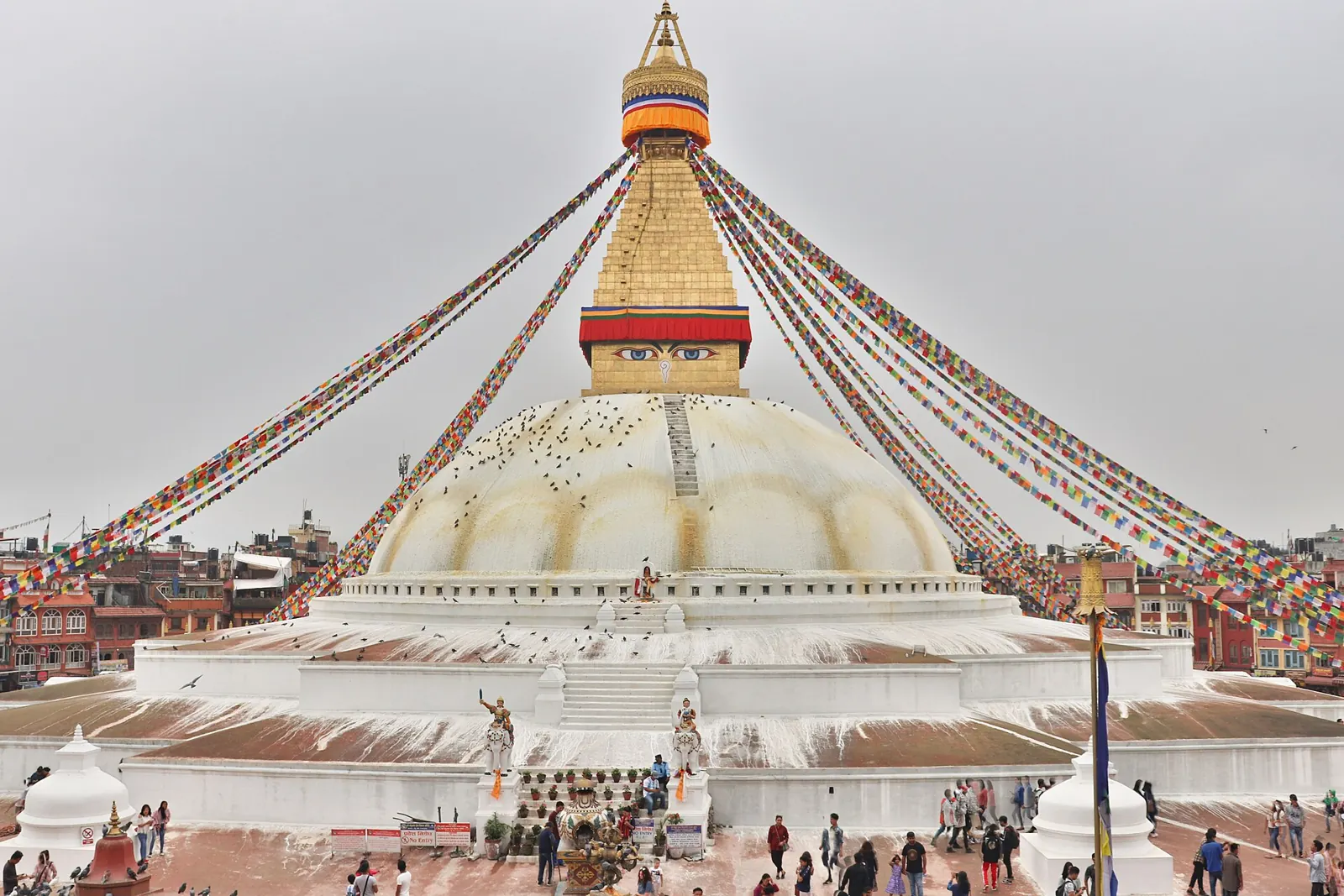
Boudha is best understood at walking pace. Join the clockwise circuit around its enormous stupa, step aside for people at prayer, and watch daily life unfold around the square. A rooftop tea break gives you a different view of the same circle.
*Entry amount is a planning estimate, not a verified current tariff. Nationality, age and museum access can change the price. Confirm at the official counter. See fees & opening times.
Know the place
History & fast facts.
Center of Tibetan & Himalayan Buddhism in Kathmandu. Cultural and architectural context to look out for while you explore.
A giant three-dimensional mandala
Standing roughly 36 meters high with a stepped plinth over 100 meters across, Boudha is one of the largest spherical stupas in the world. Its concentric terraces, hemispherical dome, harmika cube, and 13-stepped spire form an architectural mandala of the Buddhist cosmos.
Stop on the ancient Lhasa caravan trail
For centuries, the stupa stood along the principal trans-Himalayan trade route linking Kathmandu with Tibet. Merchants, scholars, and pilgrims paused here to light butter lamps and offer prayers before or after crossing the mountain passes.
108 Buddhas & 147 prayer-wheel niches
Set into the circular brick base wall are 108 niches holding stone sculptures of the Dhyani Buddha Amitabha and 147 inset frames containing copper prayer wheels—each embossed with Om Mani Padme Hum—spun clockwise during morning and dusk kora circuits.
Over 50 surrounding monasteries
More than 50 gompas (monasteries), thangka painting studios, and butter-lamp houses cluster around the circular plaza and side lanes, making the neighborhood the heart of Himalayan Buddhist scholarship and ritual craft in the valley.
Your self-guided walk
Follow your curiosity.
Suggested sequence, not a surveyed navigation route. Use the map link at each stop, and follow current signs and access rules. Check off stops as you go.
- 01
Main entrance
Buy a ticket where required and step into the square. Pause to understand the clockwise flow.
Find this stop on Maps ↗ - 02
Outer kora circuit
Walk a full circuit with the stupa on your right. Give people turning prayer wheels room to move.
Find this stop on Maps ↗ - 03
Monastery frontage
Observe the monastery entrances around the square. Enter only where visitors are welcome and follow local signs.
Find this stop on Maps ↗ - 04
Rooftop tea stop
Choose a café with a clear menu. Stay for the changing light over the dome without interrupting prayers below.
Find this stop on Maps ↗
Make time for a break
A taste of the neighbourhood.
Look for Tibetan-style thukpa and momos around the circuit. Ask about ingredients, choose food cooked fresh, and check prices before taking a rooftop seat.