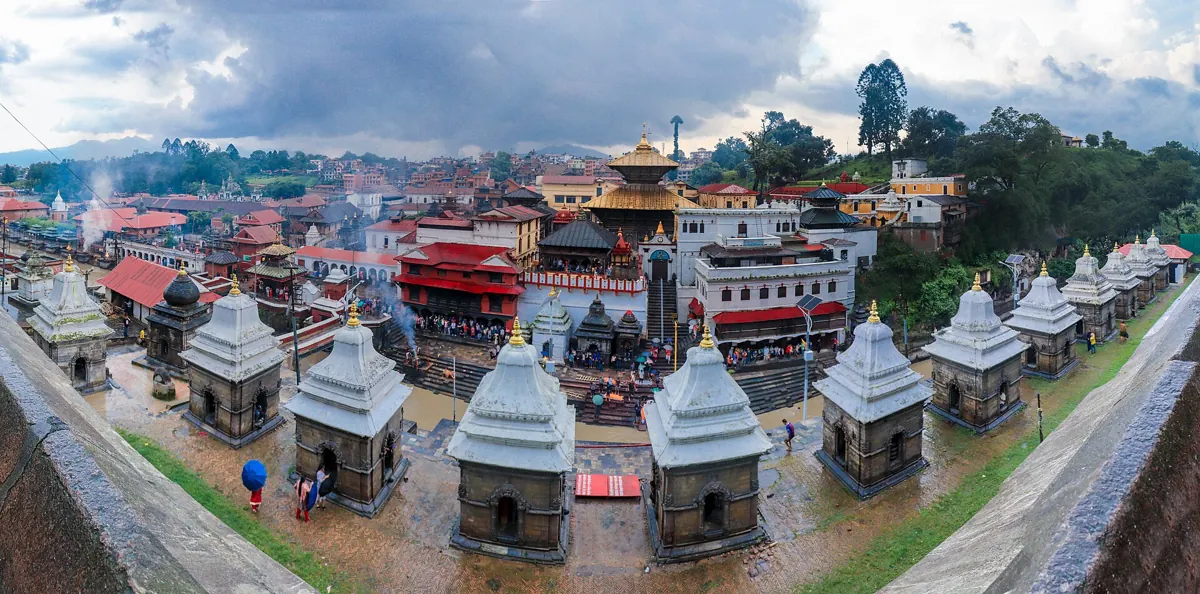
Pashupatinath is an active Hindu pilgrimage and cremation site. Your visit may include scenes of mourning. The riverside and surrounding shrines offer a way to understand the wider complex, while the main temple has restricted admission.
*Entry amount is a planning estimate, not a verified current tariff. Nationality, age and museum access can change the price. Confirm at the official counter. See fees & opening times.
Know the place
History & fast facts.
Holiest Hindu Shiva sanctuary in Nepal. Cultural and architectural context to look out for while you explore.
Dedicated to Shiva as Pashupati
Revered as the most sacred Hindu temple complex in Nepal, the sanctuary honors Lord Shiva in his protective form as Pashupati—Lord of All Living Beings. Inscriptions trace organized worship along this stretch of the Bagmati River back to at least the 5th-century Licchavi era.
The 17th-century pagoda & Nandi bull
While the inner courtyard is open to Hindus only, the two-tiered main pagoda (rebuilt in 1692 under King Bhupalendra Malla) is visible from the eastern bank, distinguished by gilt copper roofs, carved wood struts, silver-plated doors, and a colossal gilt-bronze Nandi bull facing the western gate.
The sacred Bagmati & Aryaghat
Because the Bagmati River flows south to join the sacred Ganges system, its stone steps—especially Aryaghat beside the main temple—serve as the valley’s principal open-air cremation ghats. The core sanctuary stood intact through the 2015 earthquake.
Pandra Shivalaya & evening aarti
Across the river rise the terraced stone shrines of Pandra Shivalaya and Ram Mandir, housing rows of votive shivalingas. Each evening on the eastern bank, priests perform the Bagmati Ganga Aarti with oil lamps, bells, and devotional chants.
Your self-guided walk
Follow your curiosity.
Suggested sequence, not a surveyed navigation route. Use the map link at each stop, and follow current signs and access rules. Check off stops as you go.
- 01
Visitor entrance
Confirm your admission category and which areas you may enter before buying a ticket.
Find this stop on Maps ↗ - 02
Bagmati riverbank
Observe from an appropriate distance. Avoid blocking processions or using a camera around private rituals.
Find this stop on Maps ↗ - 03
Opposite-bank shrines
Where public access is open, cross to the shrine-lined bank for a wider view of the complex.
Find this stop on Maps ↗ - 04
Quiet return
Retrace the public paths. If you hope to attend evening aarti, ask staff for the current time and viewing location.
Find this stop on Maps ↗
Make time for a break
A taste of the neighbourhood.
Eat outside the ritual areas. Keep the visit focused on the site, then continue to Boudha for a meal.