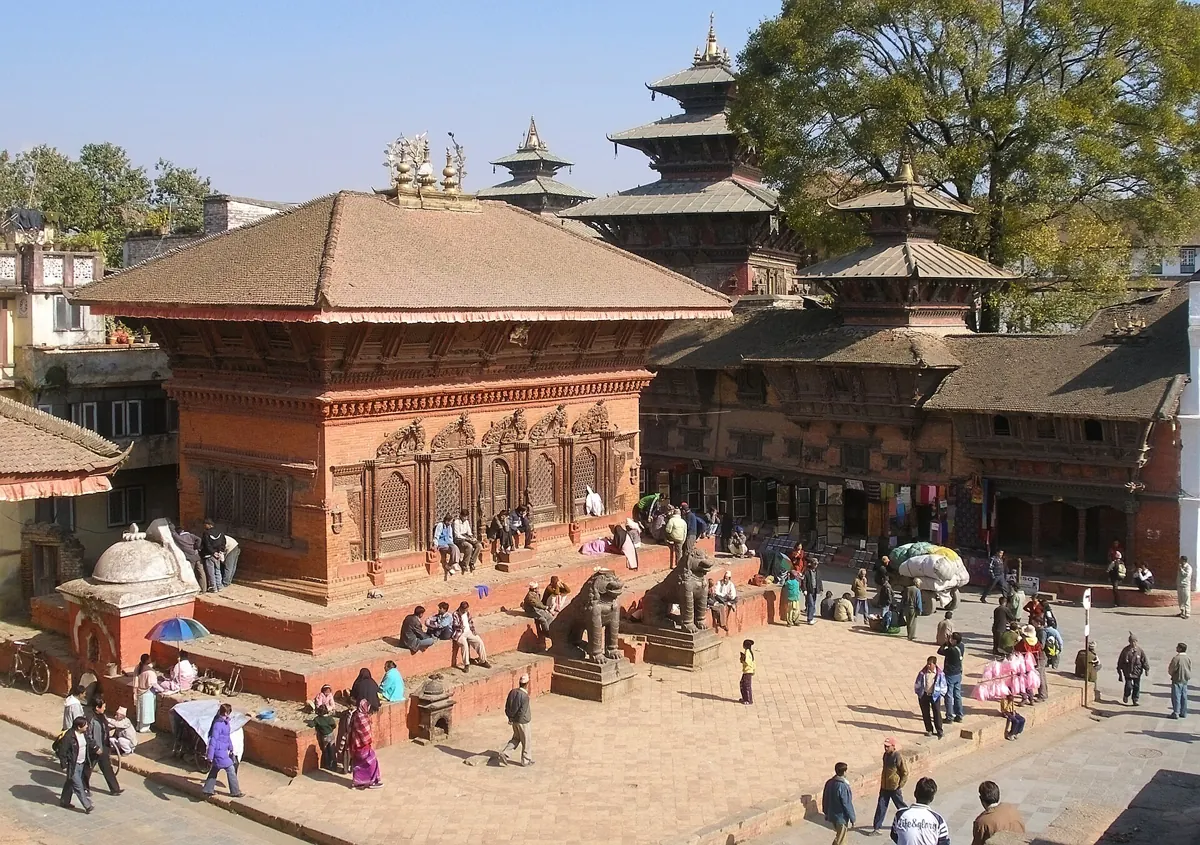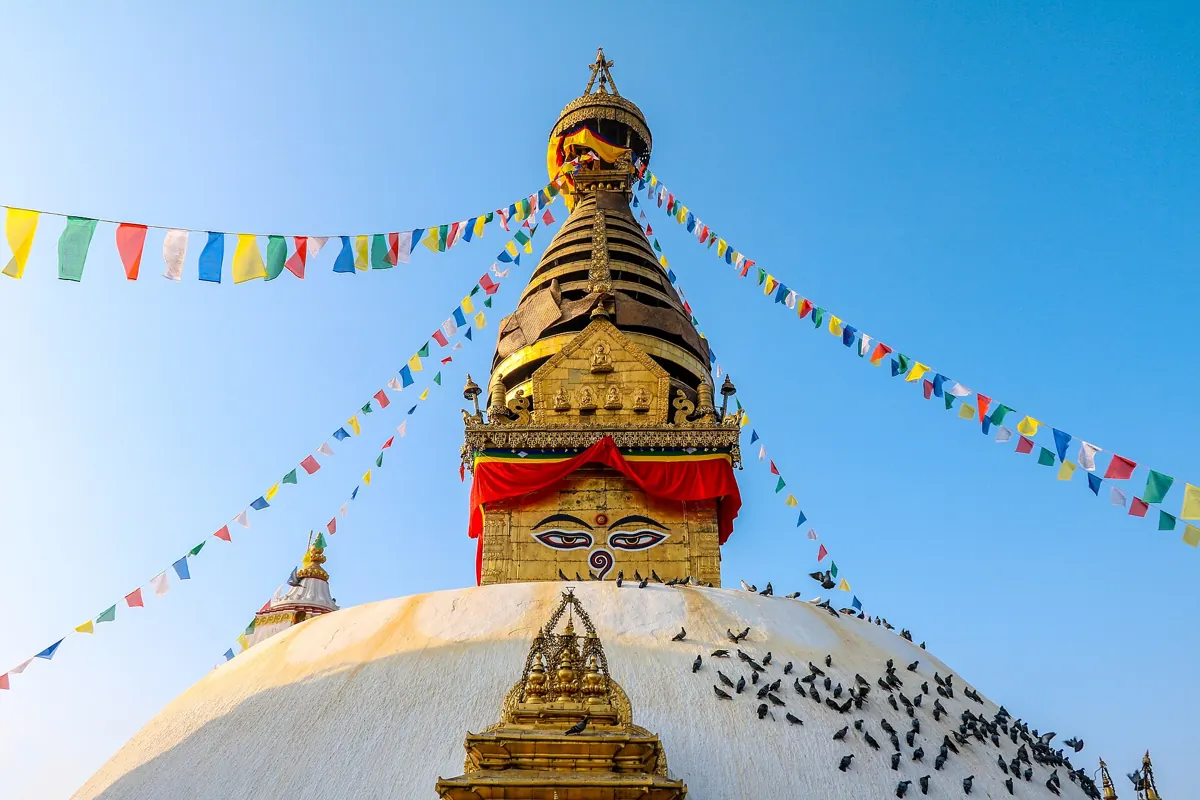
The city falls away as you climb. At the top, the white dome, gilded spire and Buddha eyes share the hill with shrines, prayer wheels and an expansive view of Kathmandu. Give yourself time to sit after the stairs.
*Entry amount is a planning estimate, not a verified current tariff. Nationality, age and museum access can change the price. Confirm at the official counter. See fees & opening times.
Know the place
History & fast facts.
Newar Buddhist & Hindu sacred hill. Cultural and architectural context to look out for while you explore.
Valley creation legend & Licchavi roots
In the Swayambhu Purana, the Kathmandu Valley was a primordial lake until the bodhisattva Manjushri cut the Chobhar gorge to drain the waters, revealing the self-arisen lotus hill. Stone inscriptions confirm active worship here by the 5th century CE under Licchavi King Manadeva.
Symbolism of the stupa
The whitewashed dome represents the earth, crowned by a gilded cube painted with the Buddha’s eyes looking out in four directions and the Nepali numeral one (एक) symbolizing unity. Above it rise 13 gilded rings—the stages to enlightenment—beneath a ceremonial parasol.
Shared Buddhist & Hindu devotion
Swayambhu is revered by both Newar Buddhists and Hindus. Directly beside the main stupa stands the two-tiered pagoda of Harati (Ajima), venerated across the valley as the protective deity of children and household wellbeing.
365 steps & the gilded vajra
The eastern pilgrim stairway—traditionally counted at 365 stone steps—climbs through wooded slopes to a massive 17th-century gilt bronze vajra (thunderbolt scepter) placed by King Pratap Malla between the twin white shikhara towers of Pratappur and Anantapur.
Your self-guided walk
Follow your curiosity.
Suggested sequence, not a surveyed navigation route. Use the map link at each stop, and follow current signs and access rules. Check off stops as you go.
- 01
Eastern stairway
Start at the base of the hill. Take the steps slowly and stop on the landings to look back at the city.
Find this stop on Maps ↗ - 02
Main stupa
Follow the clockwise circuit around the dome. Notice the Buddha eyes and the prayer wheels around the base.
Find this stop on Maps ↗ - 03
Harati shrine
Look for the shrine beside the stupa. This is a living place of worship; let worshippers pass first.
Find this stop on Maps ↗ - 04
Valley viewpoint
Finish with a quiet pause at the terraces. Haze changes the view throughout the day.
Find this stop on Maps ↗
Make time for a break
A taste of the neighbourhood.
Pause for tea around the hill. For a fuller meal, return to the streets below; keep food packed away near monkeys.